
“Is Black Dandyism a form of Politics of Responsibility (POR)?”
https://images.app.goo.gl/yJdcpQtcLxGNzj5P6

Black dandyism in my humble opinion is a specific form of the “POR” which has gained significant attention, particularly with the 2025 Met Gala theme “Superfine: Tailoring Black Style” and became a topic of discussion during this year’s NFL draft of Shedeur Sanders.
What’s Dandyism? It has deep roots in history, particularly in the post-slavery era, where negroes of “impeccable dress” were used as a way to assert “dignity and defiance” in a society that sought to confine Black identity, gags as clothing, and shoes with holes big enough to let the rain, snow, and ice soak socks.
While POR is a concept and behavior that describes how marginalized groups, especially African Americans, who often times try to combat racism by promoting certain behaviors considered “acceptable” or “respectable” by mainstream (white-dominated) society.
The idea is by showing they were clean, hardworking, moral, educated, modest and well-dressed, African Americans could counter racist stereotypes and gain greater acceptance and rights.
The term was first coined by historian Evelyn Brooks Higginbotham in her 1993 book Righteous Discontent, where she examined Black Baptist women’s activism in the late 19th and early 20th centuries. She showed how these women promoted respectability—like dressing conservatively, straightening kinky-curly hair, speaking properly, being pious, and emphasizing family stability—as both a survival strategy and a form of protest against being stereotyped as immoral or inferior.
In practice, POR:
Called for Black people to “uplift the race” through individual behavior. Was about both personal pride and collective racial image. Often emphasized middle-class values. Sometimes blamed poor or working-class Black people for failing to meet these standards.
Criticism of POR includes:
It places an unfair burden on Black people to change themselves instead of demanding changes to racist systems. It can shame or exclude people who don’t fit into “respectable” molds (e.g., LGBTQ+ folks, single mothers, youth, etc.). It implies that dignity and rights must be “earned” by good behavior, rather than being inherent.
Today, discussions of POR often show up when debates happen about clothing (like sagging pants), hair (natural hair vs. straightened), language, protest styles (peaceful vs. “loud”), or “respectful” behavior toward authority.
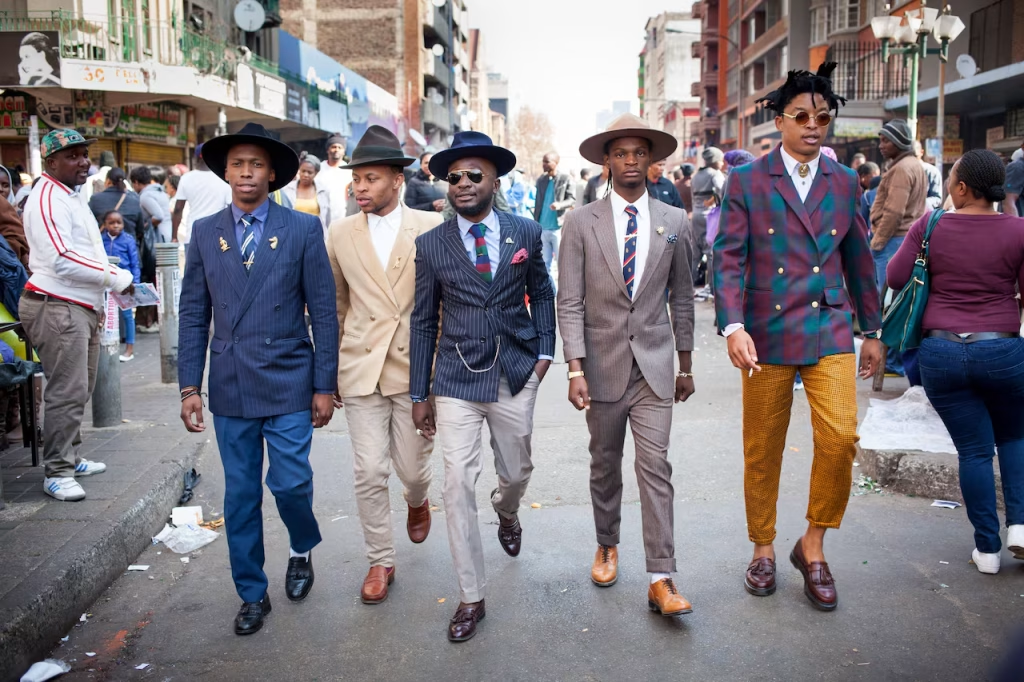
Below are some real-world examples from different periods where POR is clearly on display:
1. Early 20th century — Black Women’s Clubs
Organizations like the National Association of Colored Women (NACW), led by figures like Mary Church Terrell, promoted slogans like “Lifting as We Climb.” These women fought stereotypes of Black women as “immoral” by emphasizing modest dress, churchgoing, education, and propriety. They ran schools, orphanages, and charities, partly to uplift the race and partly to prove Black people’s “worthiness” to whites. My beloved grandmother Novella — a proud member of the Ladies Garden Club, multiple PTAa, and other community groups focused on our neighborhood’s development.
2. Civil Rights Movement (1950s–60s)
Leaders like Martin Luther King Jr. and Rosa Parks very consciously cultivated images of dignified, respectable Black citizens who just wanted basic rights. Rosa Parks was not randomly chosen to be the face of the Montgomery Bus Boycott—organizers chose her partly because she was seen as morally impeccable (a respectable seamstress, churchgoer, etc.). Protesters were trained to dress formally (suits, ties, dresses) and act nonviolently to counter stereotypes of Black people as unruly or criminal.
3. Post–Civil Rights Era / Hip Hop Era (1980s–90s)
As more Black youth culture embraced rebellion and street fashion, some Black leaders criticized sagging pants, slang, and rap music as damaging the race’s image. Figures like Bill Cosby in his controversial “Pound Cake Speech” (2004) blamed Black communities’ struggles on “bad behavior” rather than systemic racism—a black-blame version of politics of respectability.
4. Black Lives Matter (2013–Present)
Movements like Black Lives Matter intentionally push back against respectability politics. Activists argue you shouldn’t have to be a “perfect victim” (like dressed formally, no criminal record) to deserve justice (e.g., Trayvon Martin wearing a hoodie was no justification for his death nor George Floyd’s striped past). BLM activists often center marginalized Black voices—like queer and trans folks—who were historically left out of “respectable” images.
Summary
In short, respectability politics has been a tool for survival of people of color and progress, but also a double-edged sword—sometimes helping in the short-term, but reinforcing the idea that Black humanity needs to be proven rather than recognized automatically.
“If you enjoyed this blog, please like, comment, and follow! I’d really appreciate your support. You can follow me on Facebook, Instagram, and I’m practicing reels on TikTok—sharing what life in my 60s is really like.”
“This blog was created with the assistance of AI and careful research to ensure accurate and reliable information. Vr tena
Discover more from PocahontasAvenue
Subscribe to get the latest posts sent to your email.


